The soul of nature is present in the forest depths of Southern Oregon’s mountains and valleys, like a breathing being emerging from the stillness of the land. An overflowing and embracing essence that radiates life, like incense mingling with the scent and resinous weight of ponderosa pines in the breeze, and winding through the madrone groves that cut the forest with straight edges of bright bark in red oxide, and the glossy greens of their leaves. Black squirrels skitter and snatch nuts, blue streaks of stellar jays scream alarm, and gold-eyed deer stare in ruminant calm. Tall and slight, Micah Ofstedahl wanders these trees and winding trails and senses the land, the living energy of Gaia.
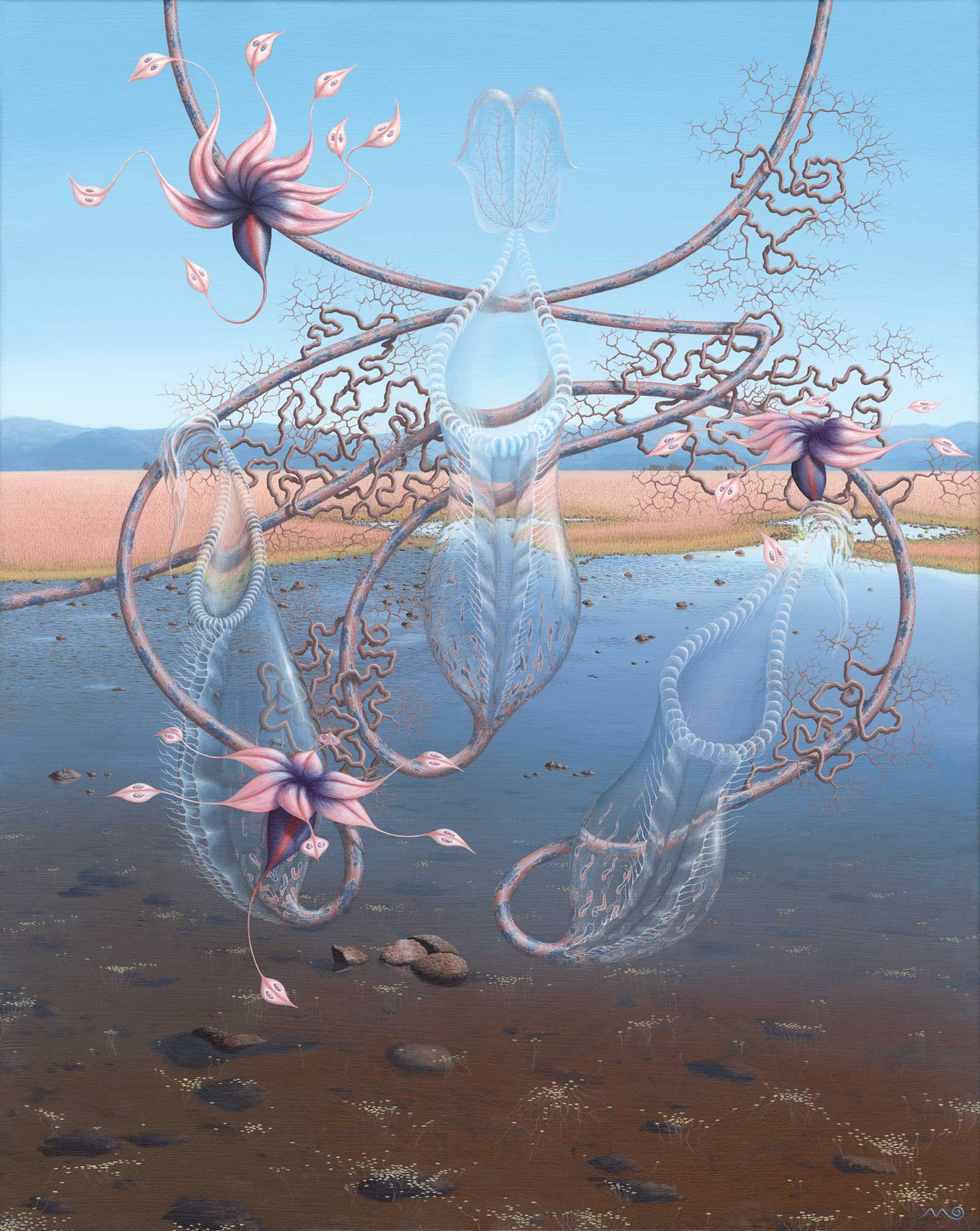 Fruitless Invitation, 2019, acrylic on canvas, 30 x 24”. Private collection.This is neither the colonial land of Emerson or Thoreau, nor the arcadia of the painters of the Hudson River School, whose elegies to the divine landscape sang of the heavenly and sublime potential of a continent gifted by God to a pioneering people to possess and steward. This is a land of extended consciousness, a land of super-sensual experience, where we are visitors. Ofstedahl walks and remembers his experiences, and back at home, works the magic of concentrating the mood of his solitude in numinous nature into masterful imagery in his tiny studio. “It comes from a love of nature,” he says, “being out here and doing a lot of hiking…the beauty of nature. That feeling you can get beyond. Rather than just painting the landscape as it is, adding that sense of mystery can possibly represent that extra feeling you’re getting being there. It could be a meditative feeling, or just a spiritual feeling, being out in nature, being in awe of it. Not even just that landscape in front of you—the whole universe can be mind-blowing, that anything exists…You could look at a little bug, or a little blade of grass, and think about the soul that’s in there, what’s happening on the level of DNA, the atomic level, and just keep going, and all of that is mind-blowing too. You could say I’m representing that as well—that awe of the universe.”
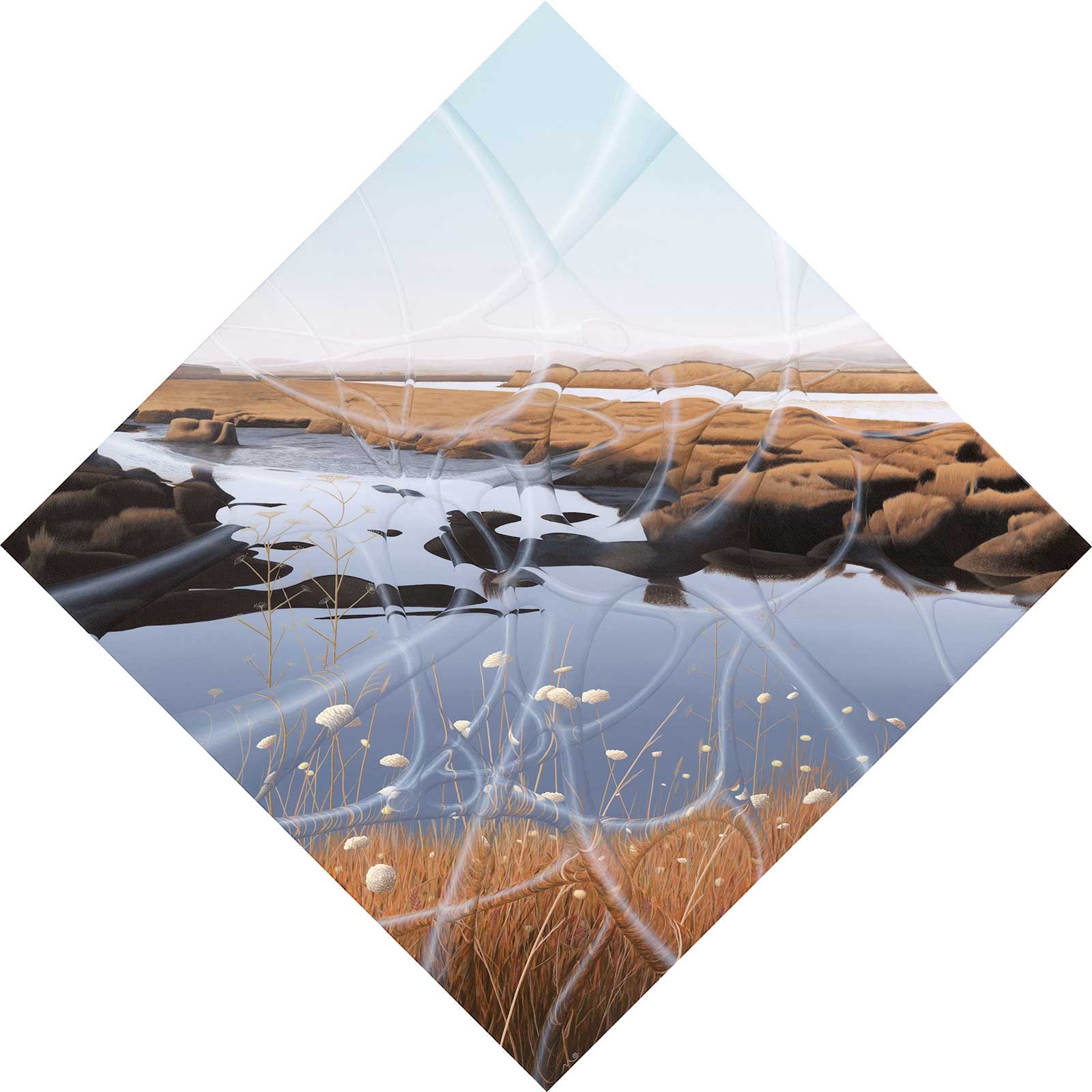
Traces of Pneuma, 2019, acrylic on canvas, 30 x 30”. Private collection.
Certain, solid, and true, then, the transparent and ephemeral energy in the bend and twist of distortion that winds through his landscape paintings is a natural phenomenon, expressing a sense of the unseen, witnessed by a self-contained man accustomed to solitude and sensitive to the subtleties of sensation. The soft edges of the human senses shape the mysteries of the known dimensions that are beyond the range of human perception, these fine fields of shimmering energy that seem to bind the universe together. Ofstedahl explains, “For one of my recent paintings, the pattern I used for the clear distorted parts came from a magnetic field around the earth. Some people see the torus field. I dabble in that mystery. Some people would say it’s absolutely real, and we have an aura, and chakras. That’s a mystery I like to think about. …I want to explore and recognize there’s more out there. It’s a mystery. These clear things can represent a lot. A magnetic field is invisible to us, but it’s real. We can measure it, observe it with special tools. Infrared, x-rays—we can observe these things, but not with our senses, our filters. Traces of Pneuma represented that interconnecting web of our past, present and future, and the effects we have on other people and the world, and vice versa, [i.e.] the butterfly effect—one little thing branches out and leads to another.”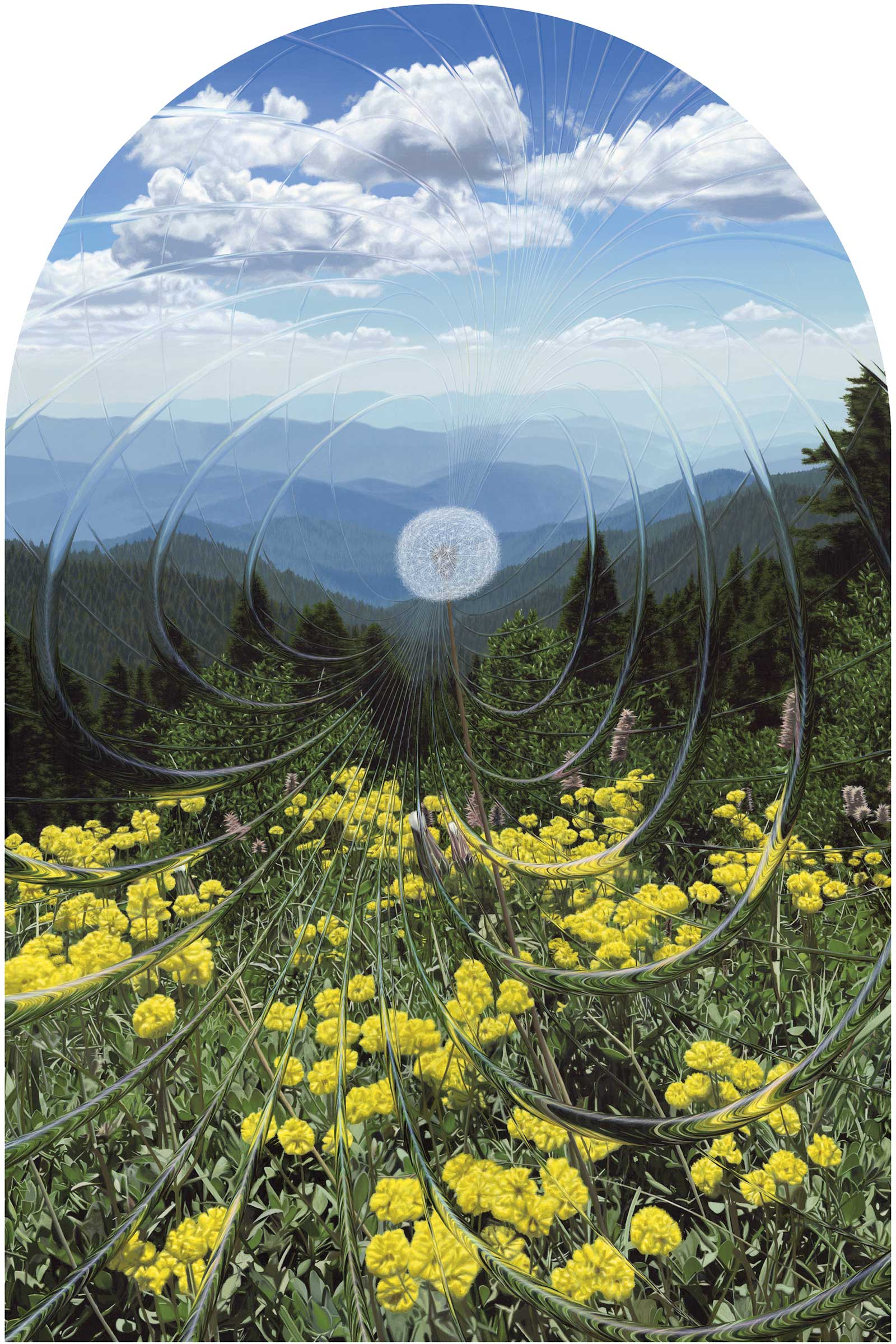
Untitled, 2025, acrylic on canvas mounted on panel, 36 x 24”. Private collection.
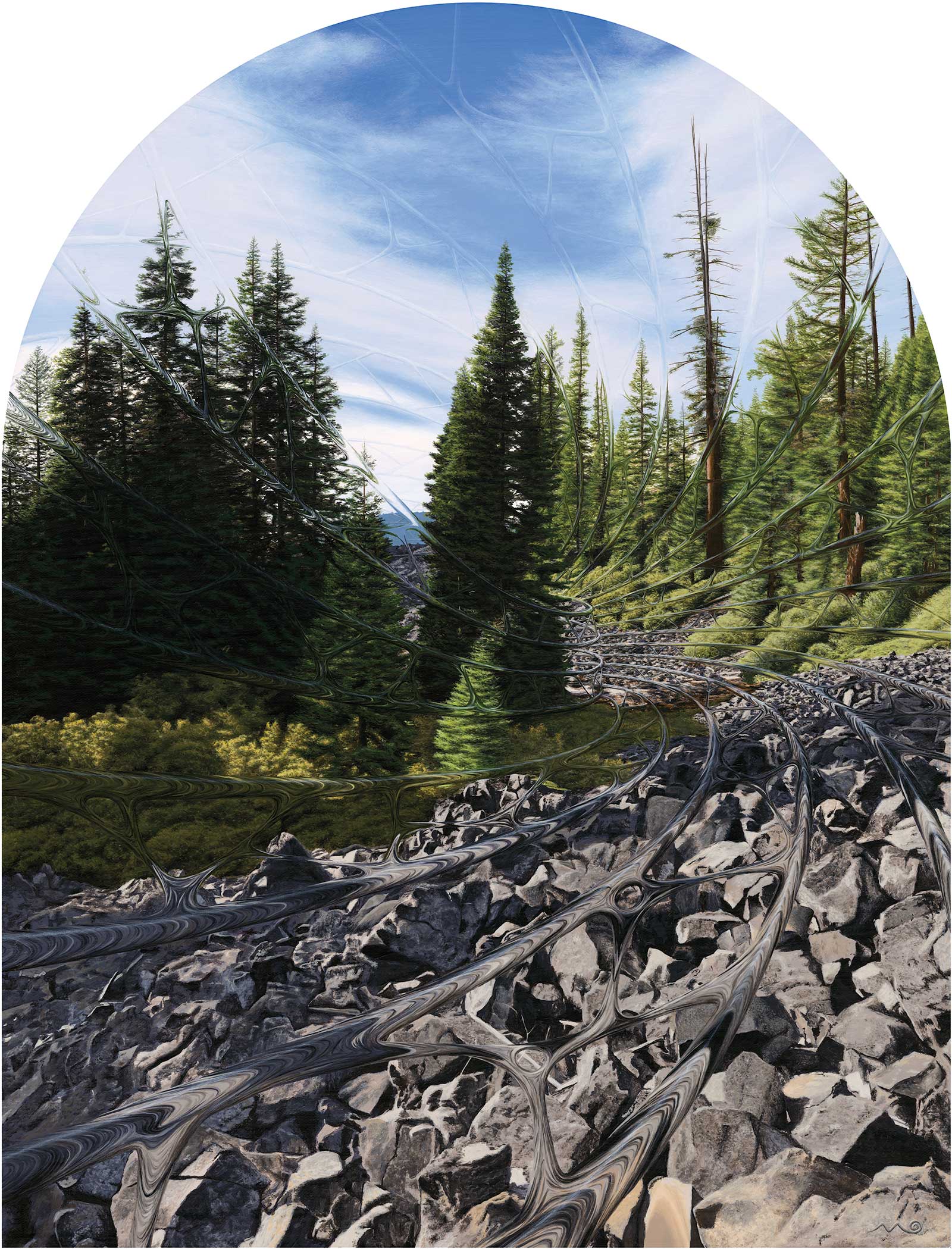
Interstitial, 2024, acrylic on canvas mounted on panel, 24 x 18”. Private collection.
His mid-century home is set beside a graveyard and sleeping there, on the edge of silence in that liminal space between life and death, seems to have made him almost translucent himself, and he moves quietly through his house in a hushed harmony with the spirits. But his is a spirit of love for the living land, inhabiting the vivid life of our ancient earth, not a morbid desire to dwell in the underworld. He has found miracles in the threshold he inhabits, where he wanders between both the tiny scale of the minute and the magnificent size of the universe, following the tradition of 19th-century microscopy with an antiquarian fascination for the unknown, and treating nature as an unknown space of wonder and delight.
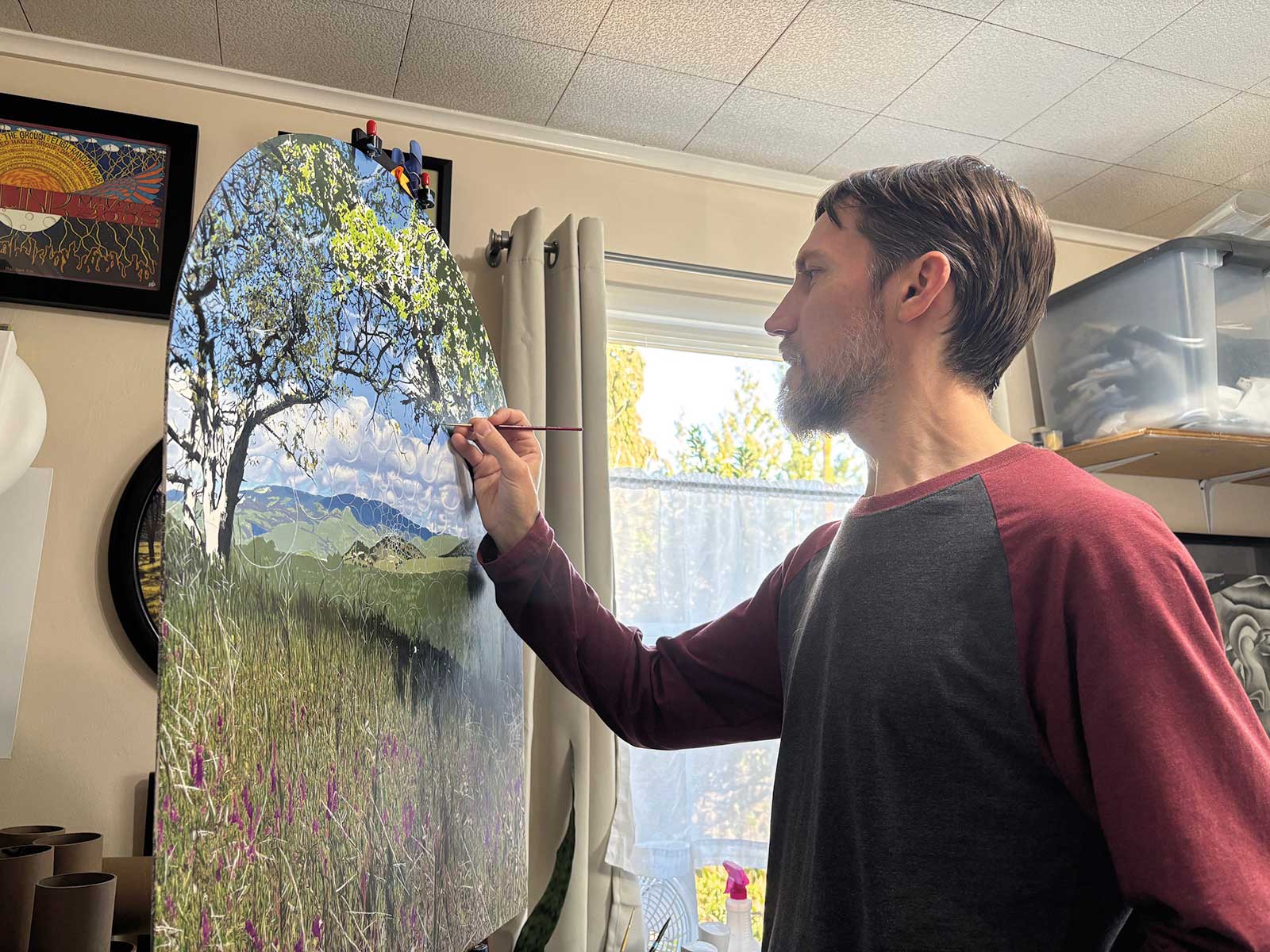 Micah Ofstedahl in his studio.
His earlier work was inspired by the zoologist Ernst Haeckel, whose drawings and paintings of microscopic biological forms are wonders of detail and the mysteries of the miniature life teeming all around us, but so small that we blunder about unaware of its existence. Intrigued, Ofstedahl imagined Haeckel’s tiny creatures blown up and set in a surreal landscape, while maintaining their invisibility. He was lured to the contrast between the strangeness of extra-sensuality and the concrete, observable reality of what we can see. Haeckel’s microscopic encyclopedia of invisible life opened a seemingly alien and unknown world of strange, beautiful and monstrous life, while evidently consistent, real and entirely natural—and Ofstedahl wondered about combining the two.
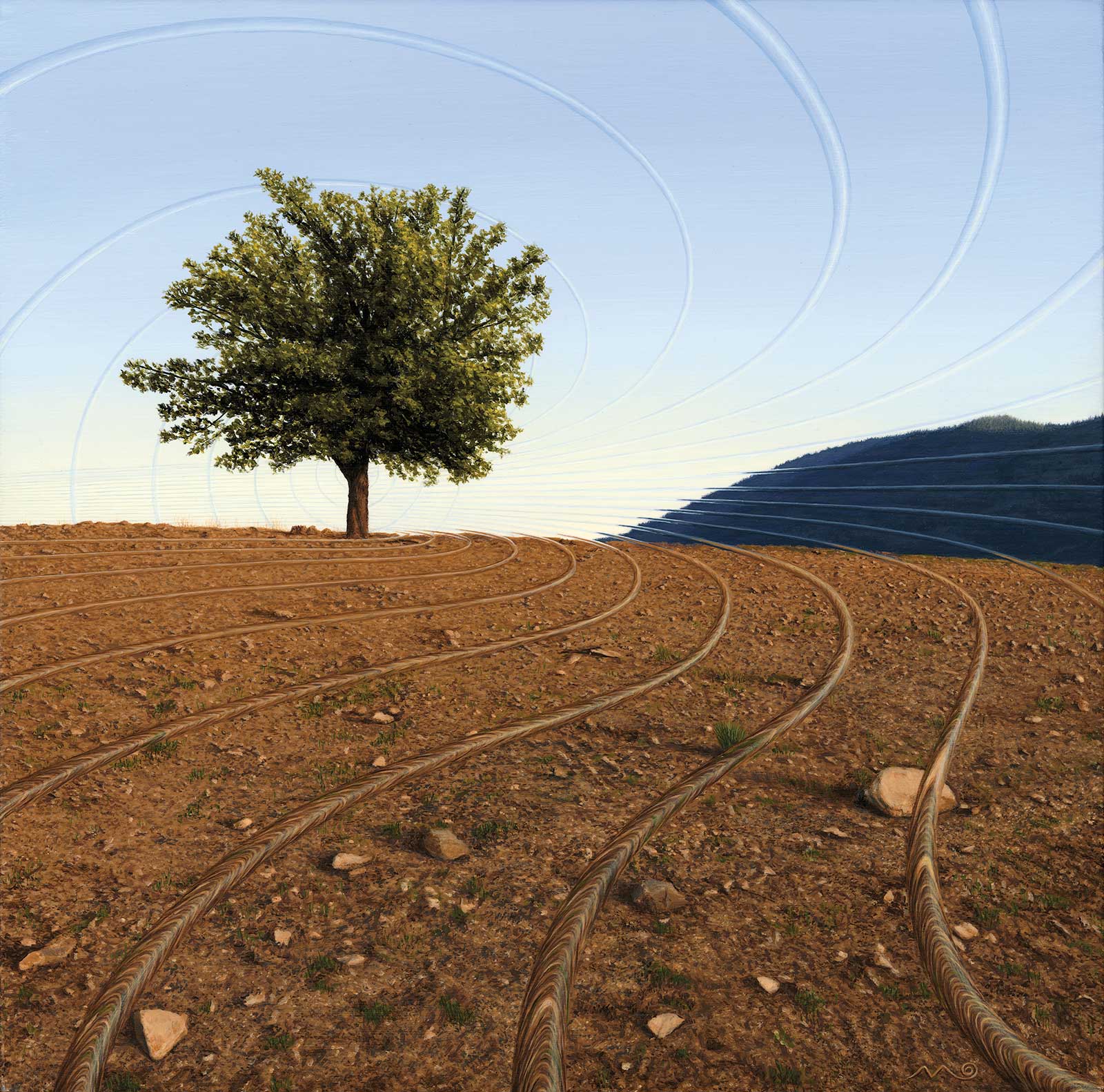
A Different Light, 2024, acrylic on canvas, 12 x 12”. Private collection.
The first painting he did with a realist background was Fruitless Invitation, a wonderfully mysterious mixture of vines curling over the calm and still of reflecting pools, where scattered algae sprout mysterious white stems, and delicately patterned rhizomes form strange but beautiful, mutated pathways on a flattened plane. Almost invisible alien flowers hover like expanding blown glass in the air. Ofstedahl explains, “I had a sketch of some pitcher plants that were inspired by Haeckel’s work. At some point I decided to use a photograph as reference and painted it fairly realistically, and painted the pitcher plants clear, and I was happy with the result. The next painting, Like a Memory, was again a realistic landscape and I used a pattern I had sketched out, a microscopic view from Haeckel, a diatom. I started making my own patterns for the clear, distorted parts, still using patterns inspired by nature, or radiolarians—microscopic, single-cellular marine organisms. My first exposure to his work was Art Forms from the Ocean, then I found some of his other work that branched off into other things. Great sources of inspiration!”
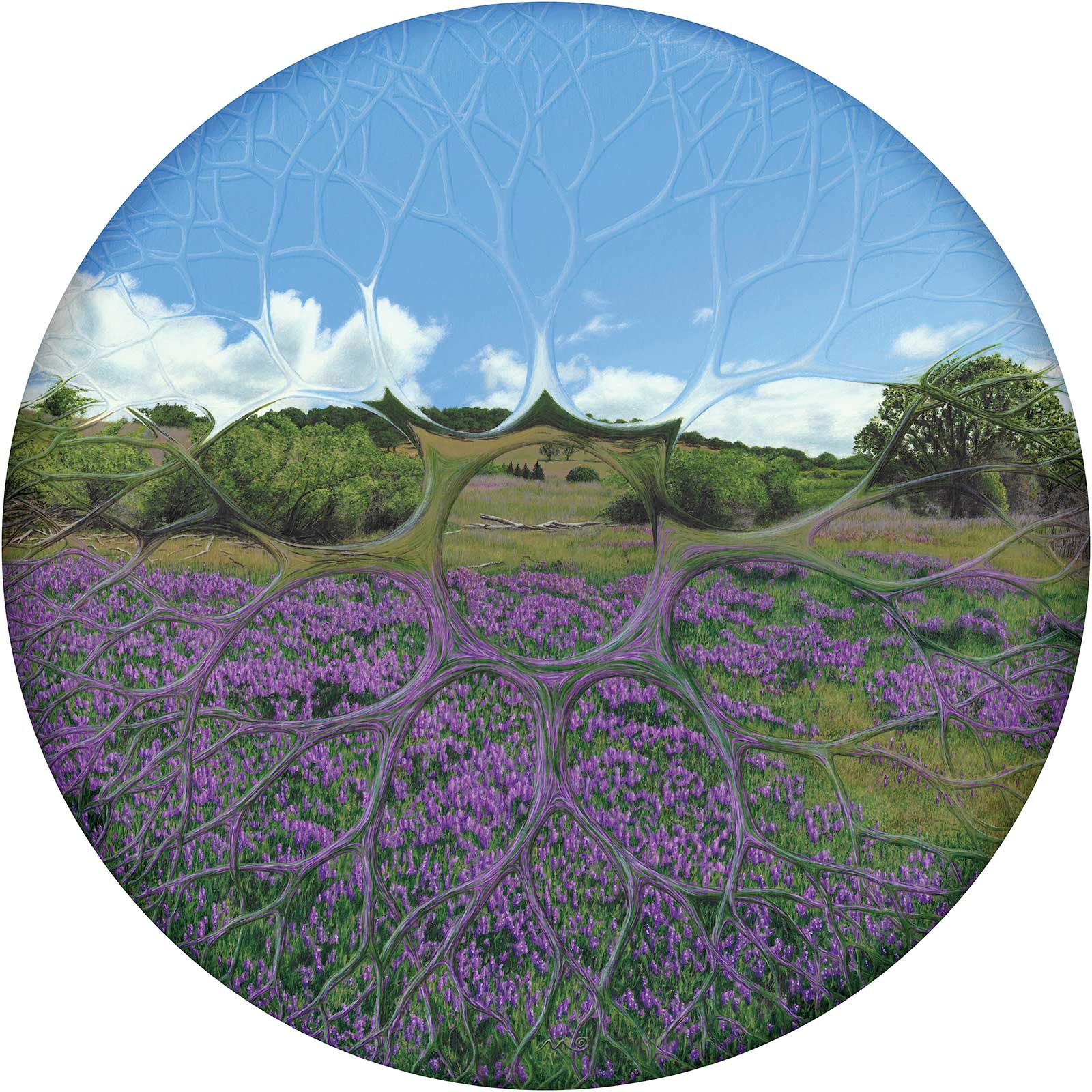
Pathways, 2022, acrylic on canvas, 16”. Private collection.
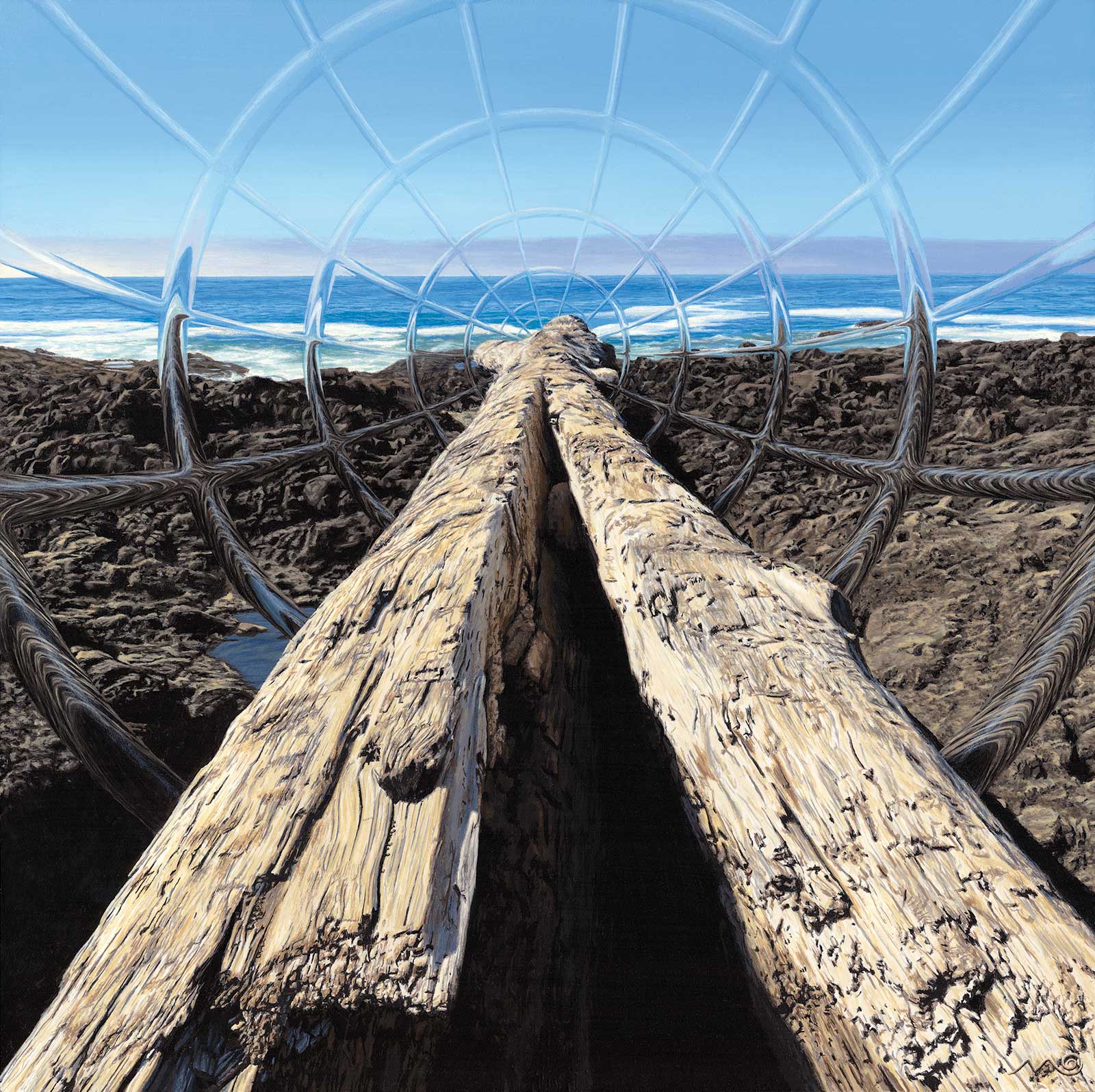
Time and Gravity, 2025, acrylic on panel, 12 x 12”. Private collection.
If Haeckel’s scientific studies led to a disorienting and imperceptible reality, other artists shaped his imagination. Ofstedahl recalls his childhood muses from grade school, “M.C. Escher and Salvador Dali were creative inspirations, and piqued my interest in art, that you could do these weird, surreal things. It really struck me that if I could paint, that was the path I would go down. You can see the influence of Dali in my earlier work. …I never thought I would paint realistic landscapes like this. There were some more current artists that inspired me, who are painting fantastic realism using realistic landscapes, like Hannah Yata, or Jean-Pierre Roy. Some of that kind of work inspired me too.”
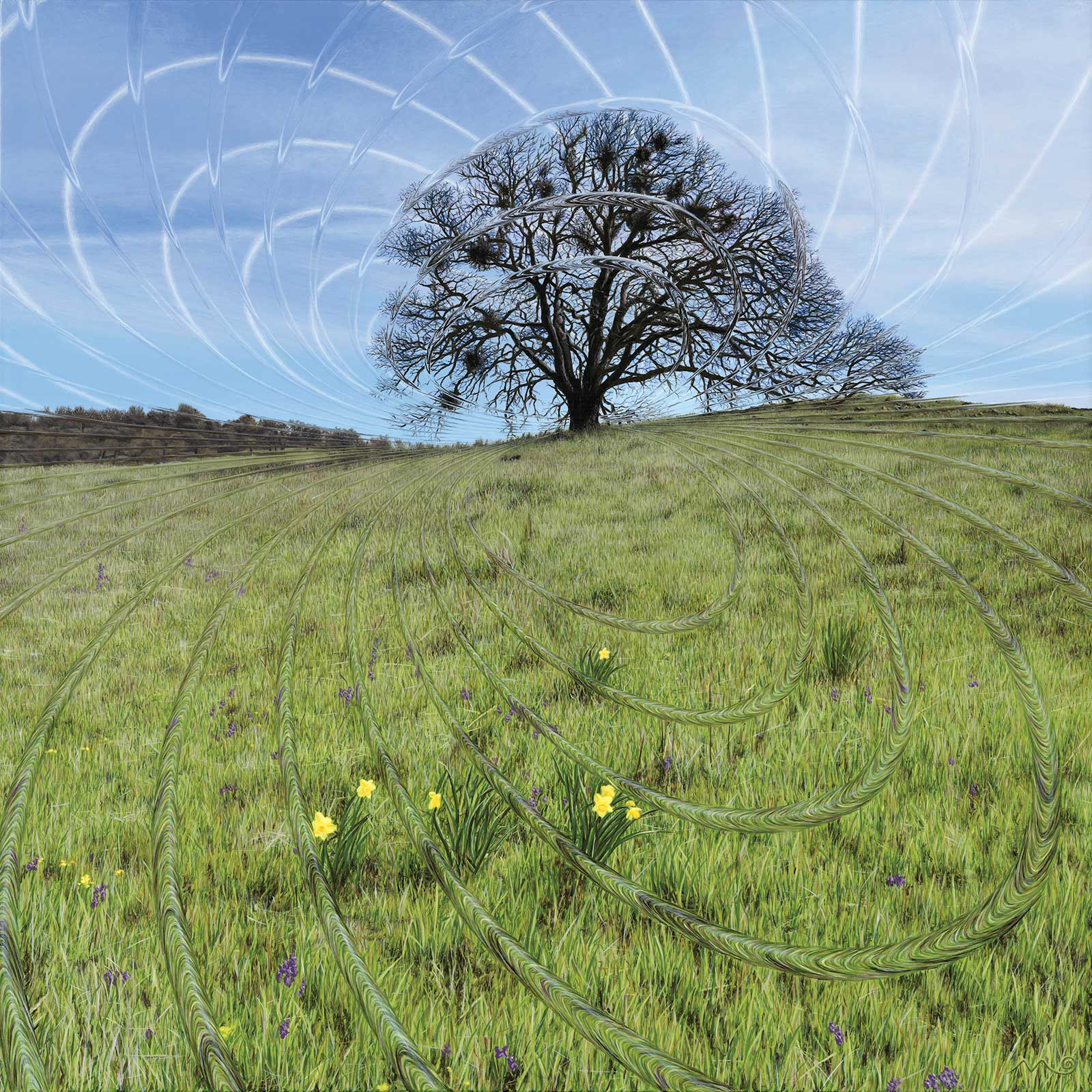
Fields, 2024, acrylic on canvas, 16 x 16”. Private collection.
Ofstedahl explains his paintings as a vision of the life of nature, but he seems to glide through reality as an otherworldly presence, a man who fell to earth, a dreamer. Perhaps the paintings are best understood as a perception of real life from the perspective of a guest of normality, created with such a lucid pleasure in natural phenomena that he seduces readers into desiring visionary experiences for themselves to see the world as he sees it from the outside in. Then the paintings are born of the tenuous and slippery place within the mind of an artist who dwells in the fragile space between dreams and reality. Every artist lives a double life and is aware of visiting illusions during periods of creative exploration. An artist is one who is uninjured by the dangers of a vivid imagination, and can wander unscathed through the places between the planes. The supreme artist is a dreamer who returns from the world of sleep with revelations, and offers a guide to life, sharing a parallel to reality that may shape perceptions by making ordinary things strange.
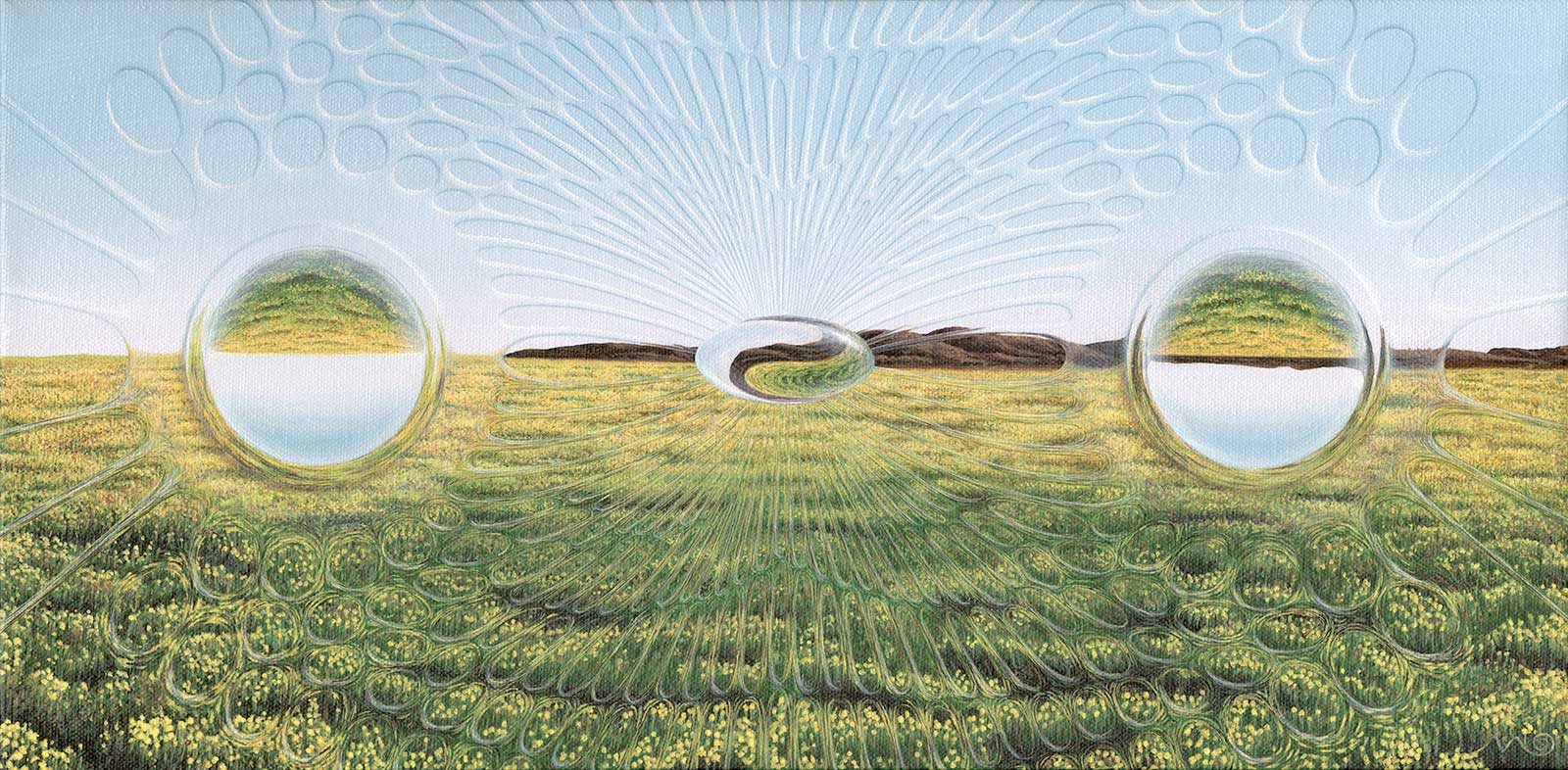
Like a Memory, 2019, acrylic on canvas, 10 x 20”. Private collection.
Passing between dreaming and waking, artists like Ofstedahl are not only imitators of the reality below, but emergent visionaries inspired by the cosmos above. They step across the bridged planes on a spiritual quest to express metaphysical truth, but always have one foot planted in the materiality that binds them to earth. Nature may be brutal, but the savagery of predation that defines survival has also led to the mystery of beauty. When an artist’s heart touches the spirit of nature, the dream and the reality unite. —
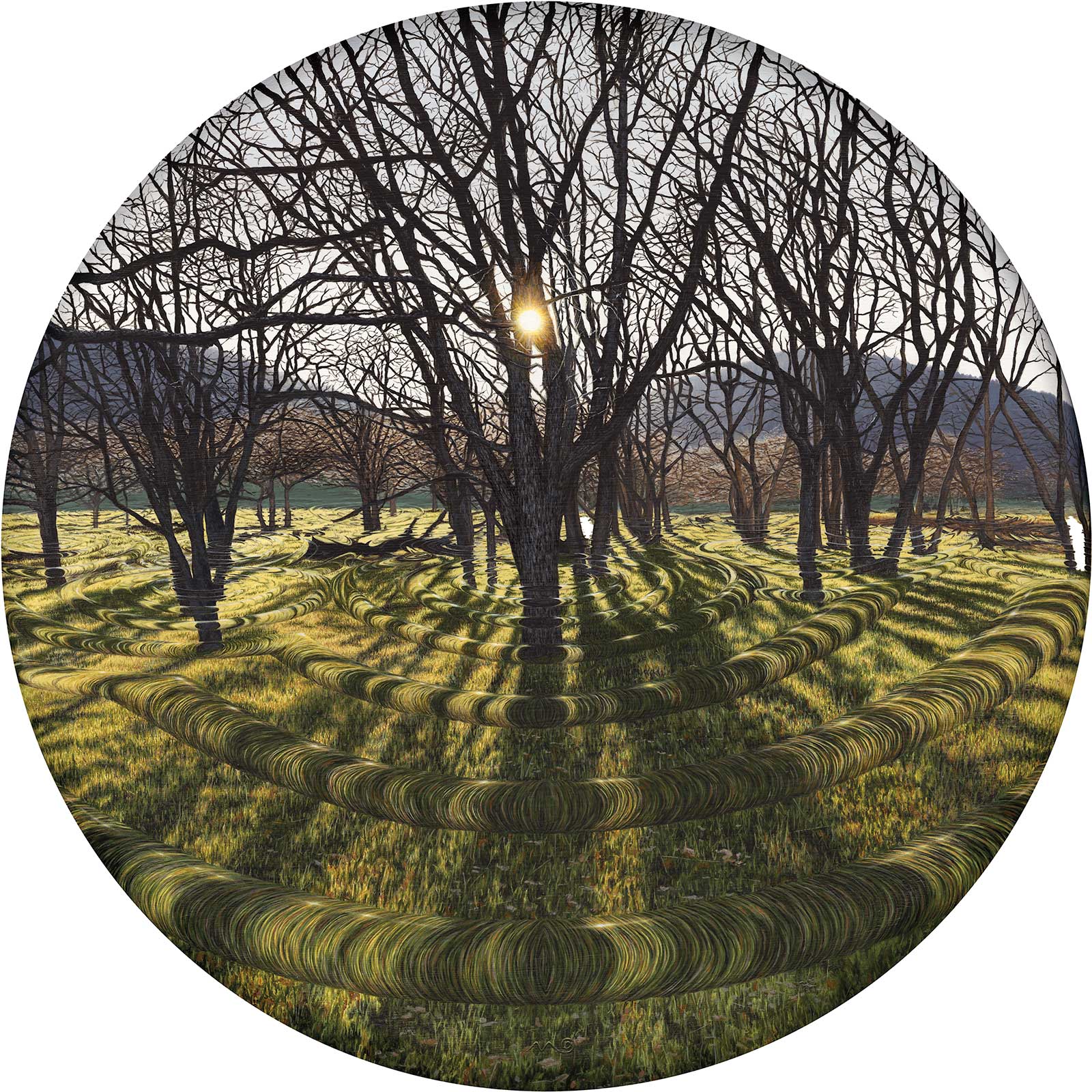
Vernal Luminosity, 2023, acrylic on canvas, 20”. Private collection.
Michael Pearce is a dynamic writer, curator and critic, as well as a champion of art that emerges from popular culture and shapes the spirit of the age. He has published hundreds of articles about art and artists, and is author of Kitsch, Propaganda, and the American Avant-Garde.
Powered by Froala Editor